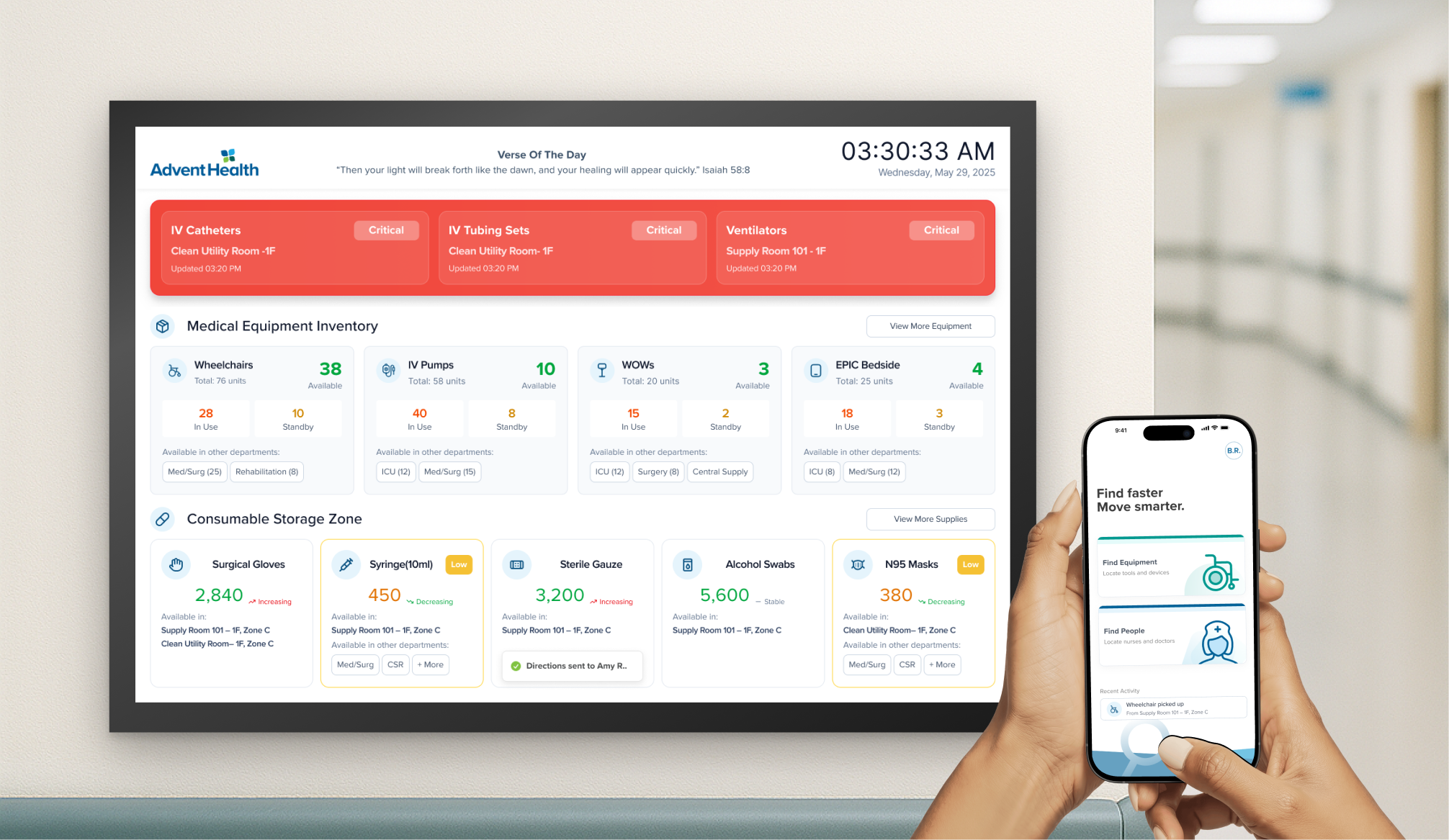
Our team built an integrated IoT ecosystem that captures real-time motion, location, and equipment usage across the hospital. I led the end-to-end design of the nurse station dashboard and the work mobile flow, enabling teams to locate tools instantly, reduce delays, and coordinate care smoothly.
Now project prototype moved to Advent develop team
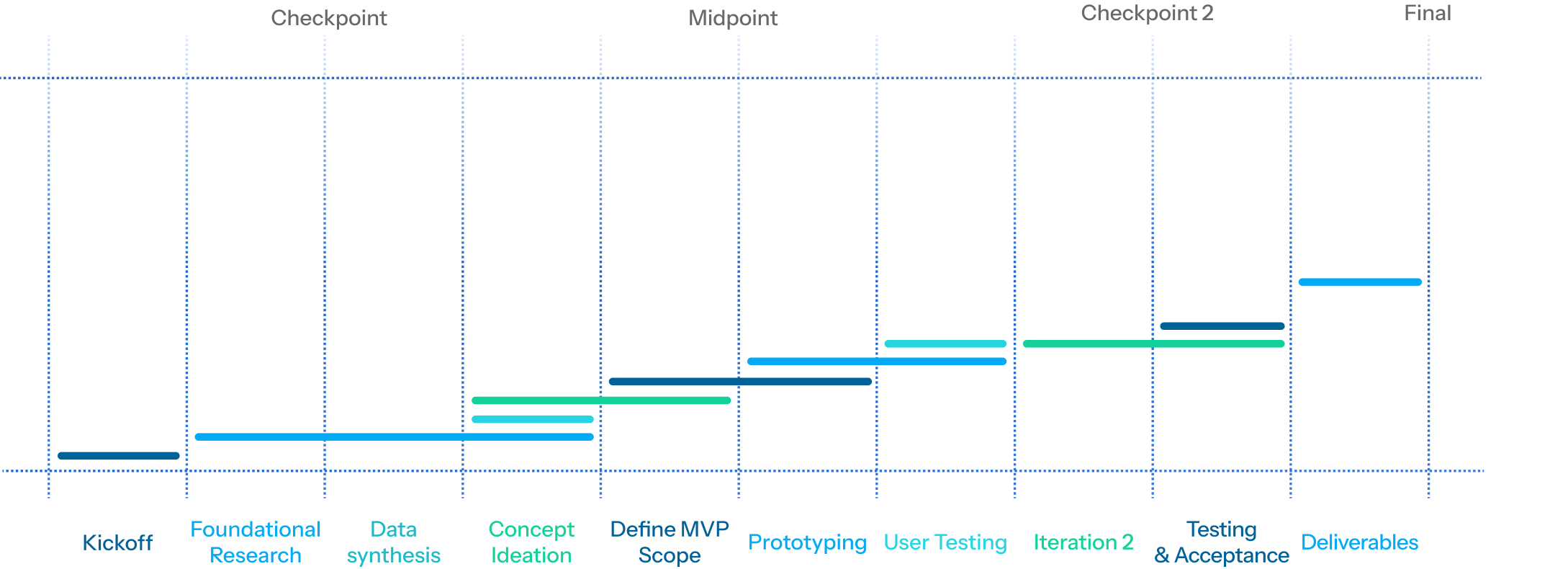
Duration
3 months | 2025 | Contract
My Role
UX Designer Lead and UX Research
Tools
Figma, Chat GPT4, Adobe Illustrator, Photoshop, NotebookLM
Teams
SCADpro Design Studio
3 UX Researchers | 2 Project Manager | 5 UX Designers
Advent health
3 Design Director | 1 Product Manager | 1 Service designer | 1 Clinical Officer
Project Overview
The daily hospital workflow is filled with unnecessary friction.
Nurses and physicians often spend valuable time searching for people, equipment, and resources. Without a unified visibility system, staff resort to manual workarounds. These non-clinical tasks create delays, increase cognitive load, and pull caregivers away from what matters most: direct patient care.
I collaborated closely with the PM and AdventHealth design team, meeting weekly to align on needs and refine early concepts. My direction was selected during exploration, leading me to design the nurse-station central dashboard and the mobile equipment-finding MVP. I led interaction design, defined key use cases, and established a scalable visual system to support both MVP and future iterations.
Impact
The system reduced equipment and supply search time by 35%, improved room-level clarity to cut location-related delays by 40%, and enabled 8 out of 10 nurses to spend more time with patients instead of coordination tasks—elevating both workflow efficiency and the overall care experience.
Highlights
Surface key supplies and low-stock alerts on the home screen, making it easier for nurses to track and handle multiple items with confidence
Provide both card and map views so nurses can quickly locate equipment—whether they need quick availability at a glance or precise room-level locations.
Allow nurses to send selected equipment locations directly to Rover phones, enabling quick in-hospital navigation through AdventHealth’s app.
Research Insights
Field trip observations and AdventHealth interviews show that clinicians still spend considerable time on non-clinical tasks—locating equipment, coordinating across departments—which reduces bedside time and increases cognitive load.

Inconsistent wayfinding and inefficient equipment retrieval force staff to rely on walking around, or asking colleagues to locate items—causing delays and frequent workflow interruptions. Despite RTLS deployment, unclear visuals and non-intuitive location cues limit its usefulness.
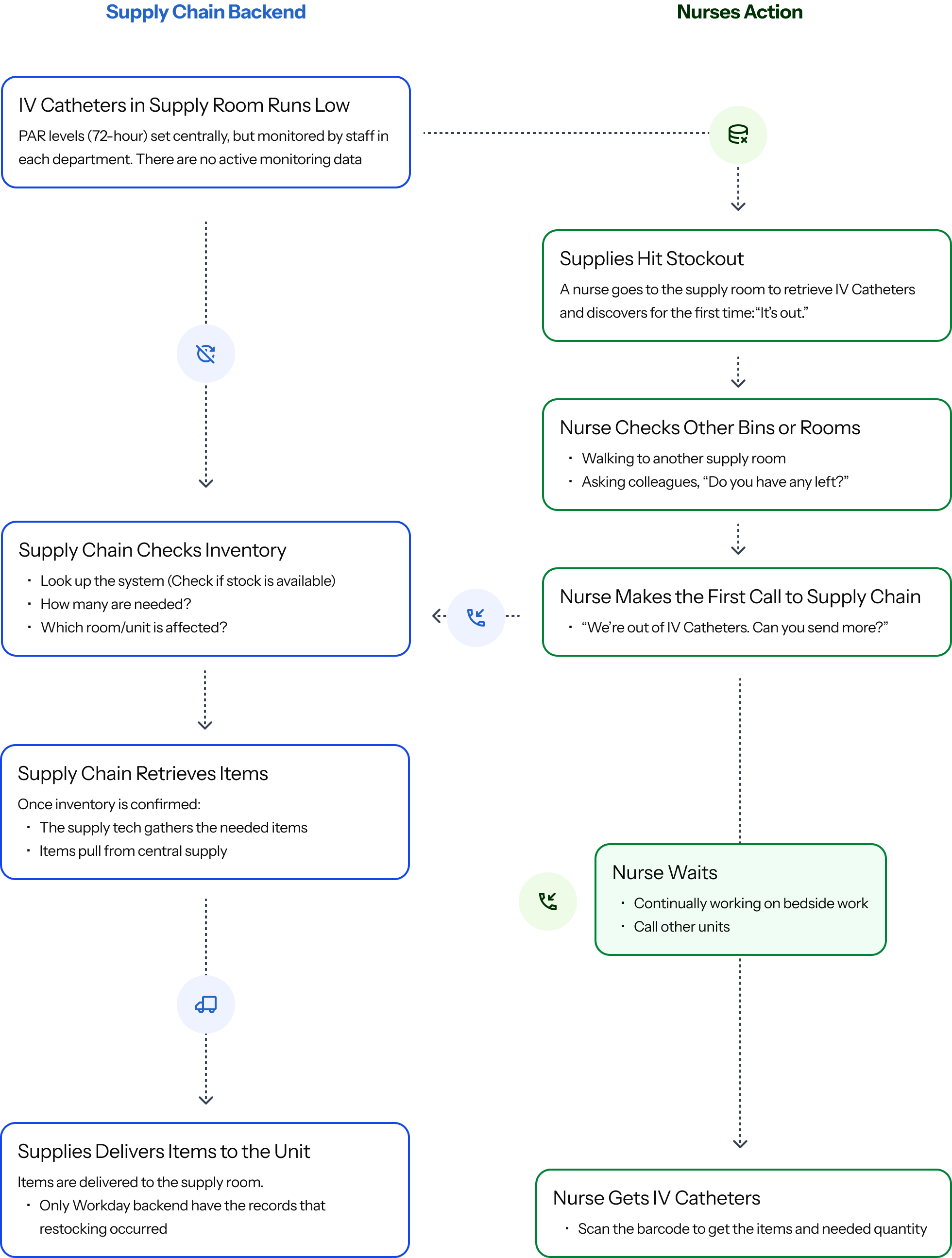
Inconsistent wayfinding and inefficient, manually tracked supply retrieval force nurses to walk around, wait, or fetch items themselves—creating avoidable delays and workflow interruptions.
By mapping the workflows, we uncovered a manual and fragmented system—one that directly translates into delays, stockouts, and repeated nurse interruptions.
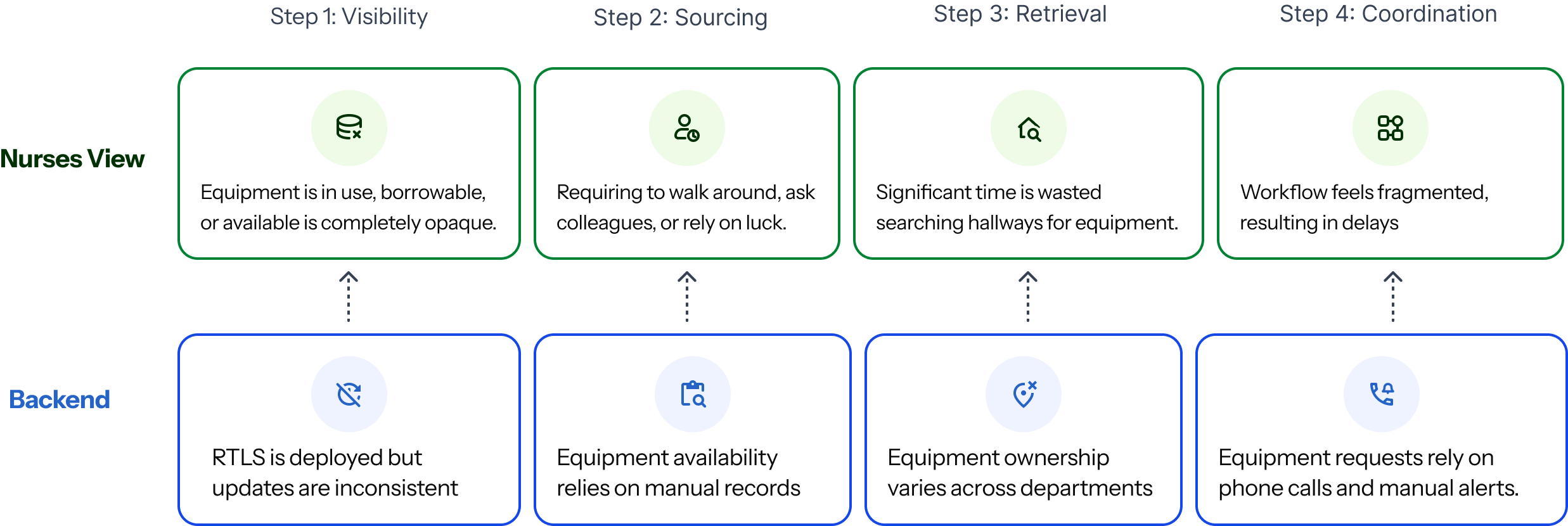
Problem Framing
01
Although RTLS is deployed, unclear location cues still force staff to manually search hallways, ask colleagues, and rely on luck to find critical equipment.
02
Reliance on phone calls and manual tracking forces nurses to fetch items themselves, disrupting clinical workflows and reducing bedside care time.
03
With no automated low-level alerts, stock shortages go unnoticed until a nurse tries to retrieve the item—causing unnecessary delays and workflow breakdowns.

Strategy / 01
The healthcare system is highly complex, and different departments have distinct needs. We cannot design a separate page for every piece of equipment, so we need a modular system that can support both supply management and equipment management.
1st Iteration
The initial design assumption was that spatial visibility was the key to solving nurses’ difficulty in locating equipment. The goal was to digitize the search process using real-time location technology (RTLS) and Passive RFID tags.
After testing with AdventHealth nurses and supply chain managers, we found that while the map view works well for wayfinding, it is not suitable for inventory or quick decision-making.
• Visual Clutter:
When many equipment markers appear on the screen, the map becomes overloaded. Nurses spend precious seconds identifying, filtering, or even counting markers—adding unnecessary cognitive load.
• Misaligned Decision Flow:
Our initial approach focused on “finding faster”, but users needed “deciding faster.” Nurses want an immediate, clear signal to judge whether an item is worth retrieving. Some terms are not hospital daily use. So we change “Idle” to standby.
2nd Iteration
Based on these findings, we shifted from spatial visualization to a more structured information architecture. The map was moved to a secondary view, while the Asset Card became the primary interface for faster decision-making. We’ve added consumable supplies support, enabling backend PAR-level tracking and forecasting per the Supply Chain manager's note.
Reusable UI components ensure consistency across the product and accelerate development by reducing repetitive design and coding work. low-priority.
Strategy / 02
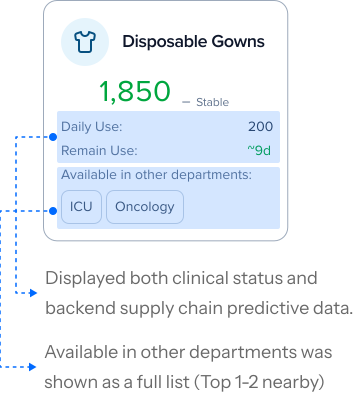
Even with a modular card design, we found that secondary cognitive load persisted. Supporting details within the card still distracted nurses during quick scanning. We needed to decisively remove non-essential information and strictly focus the UI on triage-driven decision actions.
Even with a modular card design, we found that secondary cognitive load persisted. Supporting details within the card still distracted nurses during quick scanning. We needed to decisively remove non-essential information and strictly focus the UI on triage-driven decision actions.
High (Retained)
Supply Management
• Critical & low alerts
• Availability counts
• Supply trends (backend par level monitor)
• Available location in this zone (to rover phone)
• Cross-unit availability (only show critical&low)
Low (Removed)
Par Tracking System
• Daily Use Amount
• Remaining Use Days
• Department Lists for every item
• Add equipment/supplies
• Historical Forecasts logs
• Expiration Date (go to backend)
3rd Iteration
Initial Design

Streamlined Design
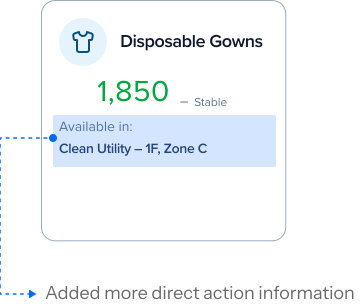
By removing secondary data, we reduced on-screen data noise by nearly 50%, ensuring nurses can interpret a card within 2 seconds—achieving true at-a-glance visibility.
While the streamlined card hides cross-department availability in normal situations, we re-introduce this information only when it supports critical & low situation.
Results
Empower AdventHealth to build a people-centered smart hospital by simplifying how clinicians find and act on equipment and supply information. The MVP reduces search time, minimizes interruptions, and improves decision clarity—giving staff more time for patient care.
Finalized design accepted and transitioned to the internal design and development teams.
Solution

Empower Total Clarity through Unified Asset Visibility
Challenge: "Can’t find items" and "Lack of Real-Time Visibility"
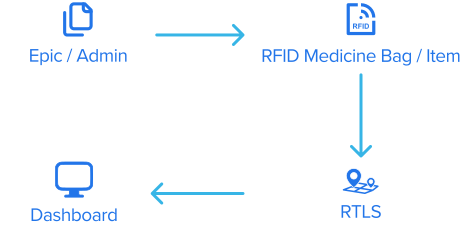
• Equipment and consumables are managed within a single system, providing cross-asset visibility.
• Integrated Real-Time Location (RTLS) data & RFID with Real-Time Inventory (EPIC / PAR Data) to establish a single source of truth.
• Follow Advent Health’s design guideline with their app

Impact
Reduces staff walking time, search time, and workflow interruptions.
Support Faster Decisions with Action-Driven Asset Cards
Challenge: "information overload" and "difficulty in making immediate judgments"
State-Driven Actions
Define Normal, Low, and Critical states first to guide faster, condition-based actions
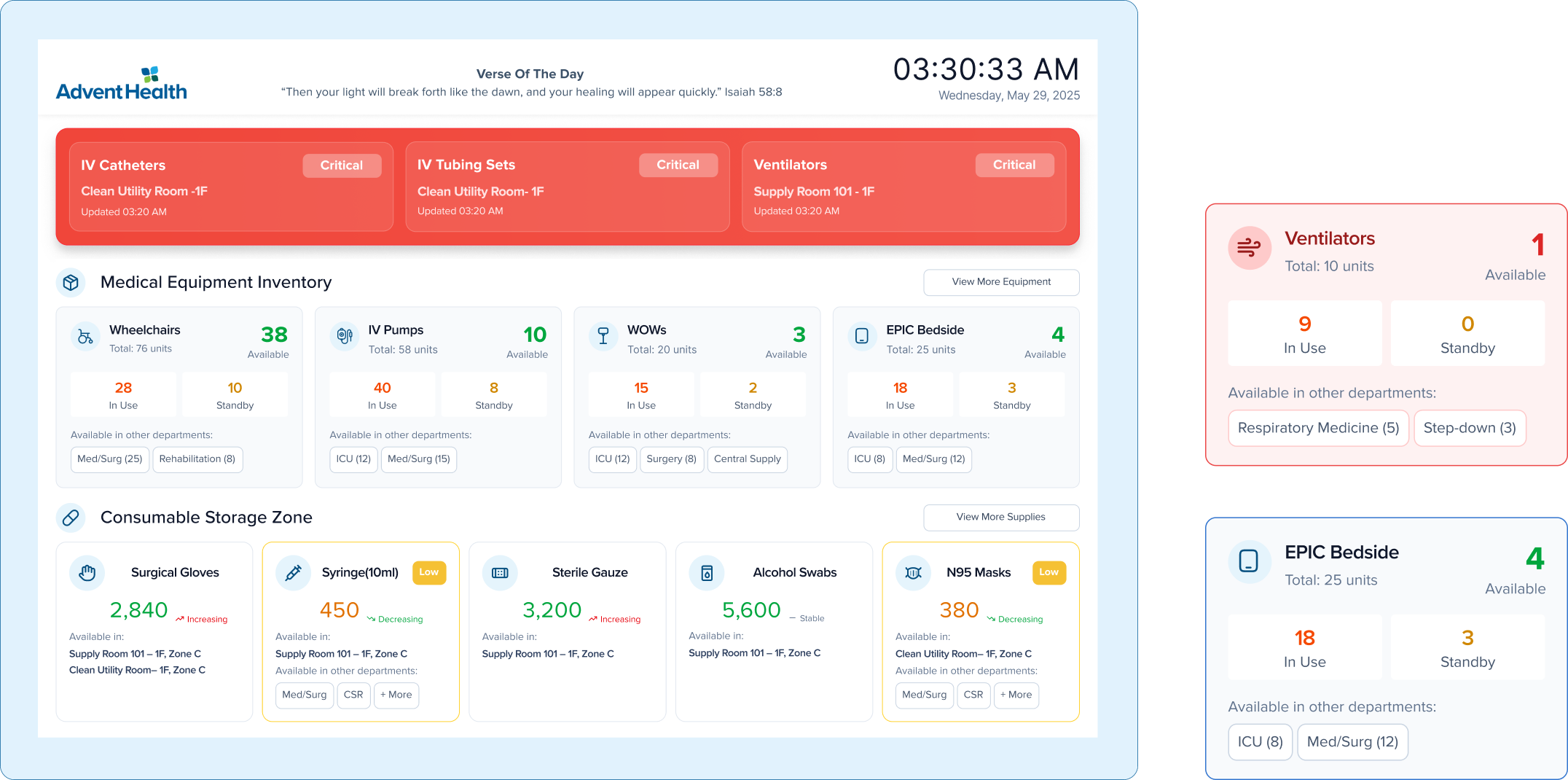
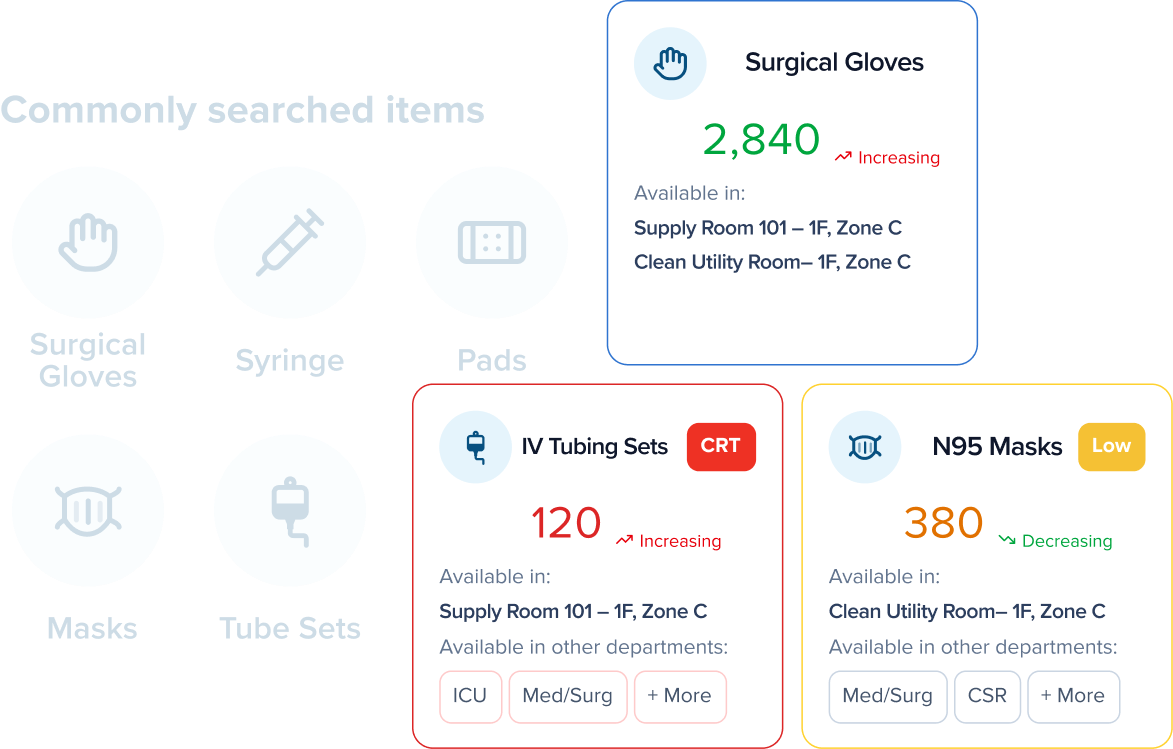
Decision-First Structure
Reveal cross-department availability only when needed to support timely reallocation. Prioritize decision signals first to ensure every card element leads to action
Impact
Enables 2-second judgment, leading to faster decisions and quicker action.
Support Faster Decisions with Action-Driven Asset Cards
Challenge: "information overload" and "difficulty in making immediate judgments"
One-click Visibility
Instantly view real-time equipment availability without leaving the triage view.
Precision Dispatch & Wayfinding
Enable clinicians to select nearby staff based on real-time proximity and role (via EPIC staff binding), and instantly send turn-by-turn directions to recipients’ Rover phones for immediate retrieval.
Impact
Reduces repeated trips, coordination friction and phone calls across departments.
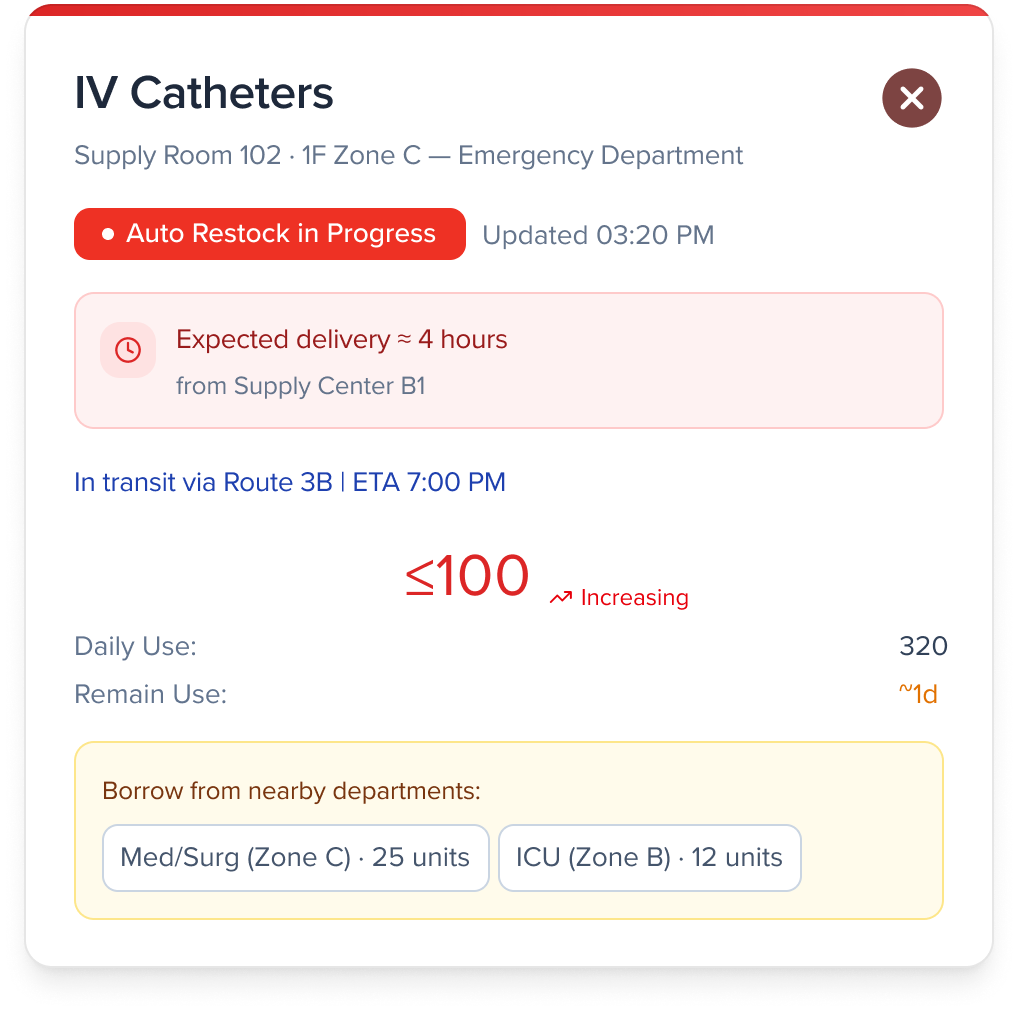
Empower Proactive Readiness through Smart Supply Forecasting & Alerts
Challenge: "Stockout Only Appear at the Moment of Use"
PAR-Integrated Monitoring
Connect with EPIC’s PAR-level tracking (IT approved) to detect low inventory before shortages occur
Predictive Alerts
Trigger low-level alerts early to initiate restock or reallocation ahead of depletion


Transparent Critical States
Surface Auto Restock in Progress and ETA information when inventory reaches Critical status
Impact
Enables 2-second judgment, leading to faster decisions and quicker action.
Results
The project has now transitioned into the development phase, with engineering teams beginning implementation planning. The design now serves as a production-ready reference for development to reduce non-clinical burden and return time to patient care.
What I learned